Showing posts with label telecoms. Show all posts

21 October 2019

Blog post: Tech policy and deals outside of Westminster

While Westminster once more turns to the government’s Brexit deal, there have been interesting deals and dealings in technology this past week. US private equity company Thoma Bravo acquired Oxfordshire-based cybersecurity firm Sophos for £3.1 billion. This acquisition can be interpreted as both and bad news for UK businesses. The ability to create a strong company so that it attracts international investment is a good sign of UK competitiveness. But then, a weak Sterling makes UK companies a cheap acquisition target, so there are also concerns. Further takeovers are likely to make the sell-out voices louder.

There was a more muted response when US investor KKR announced its intention to spend £500m on a majority stake in Hyperoptic, one of the altnets – telco providers with the financial resources and technical capabilities to build their own fibre infrastructure. With the government’s announcement to spend £5 billion on a nation-wide full-fibre broadband, KKR’s move makes sense. The political will to overhaul the UK’s connectivity has now also officially confirmed in the Queen’s Speech, and regardless of political developments, it seems likely that both incumbents as well as altnets will see financial gains. All they now need is that the actual laying of fibre cables will become easier.

8 October 2019

Blog post: The commitment has been made – but we need more to add fibre to our diet

The Government is in determined election mode, only with no election to fight, for now. While the Prime Minister and his senior colleagues make their appearance at the nation’s hospitals, it is in areas like infrastructure and technology that are also receiving the attention of Ministers. The recent announcement that the Government is planning to support full-fibre rollout with £5 billion was met with what could at best be described as lukewarm applause.
Full-fibre – a fibre-optic cable running directly into a building, thus vastly increasing Internet access speeds – has been high on the political agenda in the UK for years. The country plays catch-up with other European countries, so the Government’s intent is to ensure that while the UK is doing that, no part of the UK falls behind. The financial support is therefore specifically aimed at the “hardest to reach 20% of the country”, meaning mainly regions in the North.

11 June 2019

Article: Brands should stress societal benefits of 5G

My views for BrandZ's 2019 Telecom Insights:
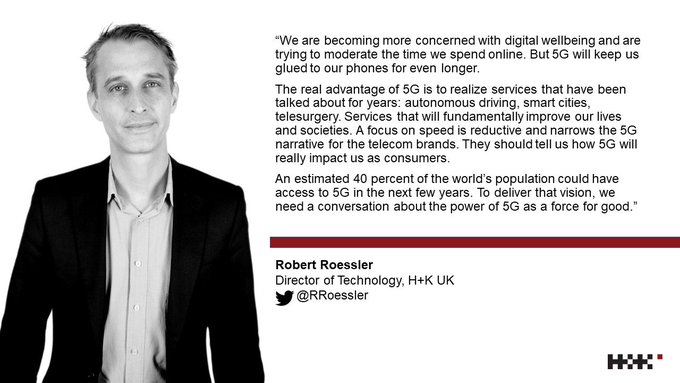
"With Donald Trump’s earlier call for 6G signals, we should reflect on whether the current hype around the “Gs” helps telecom providers—or not. They now focus on speed, with the promise that 5G will be great for gaming and watching movies. While this is true, it creates a dilemma: We are becoming more concerned with digital wellbeing and are trying to moderate the time we spend online. But 5G will keep us glued to our phones for even longer. The real advantage of 5G is to realize services that have been talked about for years: autonomous driving, smart cities, telesurgery. Services that will fundamentally improve our lives and societies. A focus on speed is reductive and narrows the 5G narrative for the telecom brands. They should tell us how 5G will really impact us as consumers. An estimated 40 percent of the world’s population could have access to 5G in the next few years. To deliver that vision, we need a conversation about the power of 5G as a force for good."

Promoted via @HKStrategies:

Image


3 July 2018

Article: Telecoms must stress how they make life better

Telecom providers go through another challenging year of competition, consolidation and contraction. To be successful, telcos need to focus on other c-words: providing compelling and unique content, adjusting to consumption patterns and delivering convenience to consumers.

To do this, they will need to re-define their place in the era of tech giants that are diversifying in the experiences they bring to people and the things they talk about. More than ever, telcos now need to move the conversation away from mobile data plans and connectivity to playing a more central role in the lives of humans and societal progress. Some brands have already started with this, by talking about technologies such as Artificial Intelligence and 5G and why they are important for our lives - rather than talking about the technologies themselves. We will see more of this.

Consumers will align with telecom providers only when they understand what they stand for. Communicating their purpose clearly will be vital for telco brands. Expect more business-to-human communications from them.

My comments on the c-words that matter for telcos in this BrandZ100 report:
http://online.pubhtml5.com/bydd/rxhd/#p=244

5 August 2008

VoIP - threat or opportunity

According to a couple of websites, iPhone users shortly will be able to circumvent their operators' networks by using VoIP. Belgian developer Namado/Namando Telecom claims that by using their application, callers can save up to 80 per cent connecting to the internet via the terminal's wifi connection.
This is undoubtedly an extremely imteresting topic, so I wanted to learn more about the small and innovative company behind the application. Now, Namado Telecom does not exist (as this is equivalent to not being found with a homepage by google). Namando Telecom does not exist as well, nor does Namado or Namando Telekom.
The company's correct name is Nomado Telecom, and it really does exist. And I think that they have a right to being spelled correctly, as they might pose a threat to mobile operators - or a massive opportunity, depending on the point of view. And that's definitely worth being noticed.