22 June 2020

Article: Communications aim at audience of policy makers

My views for BrandZ's Global Top 100 Most Valuable Brands 2020, published in June 2020:

Communications aim at audience of policy makers
As regulators look at emerging technologies, such as AI, tech companies are working to ensure that regulations are in their favor. They believe, probably correctly, that when it comes to creating regulations for the tech industry, they often have greater expertise than the policy makers.
From a communications perspective, we’re seeing more budget allocated to public affairs and corporate reputation work. The communications programs are building on information about products as tech companies speak to an audience of policy makers about the human benefit of these products and their corporate contributions to society.

20 January 2020

Campaign: The Gatekeeper's Big Day - cyber-security for kids

My team and I used the insight that many cyber-security professionals struggle to explain to their children what it is they do at work to create a physical book which does exactly that: explain to kids what it is cyber-security professionals do at work.
We worked with French cyber-security start-up Alsid an an amazing kid's book illustrator to narrate the story of a gatekeeper who prevents a thief from stealing the king's treasure. The book was produced in 500 copies each in French and English, which were sent and given to customers and prospects at events and conferences. Feedback was overwhelmingly positive and the book was re-printed due to high demand. A sequel is currently being planned.

5 November 2019

Blog post: We should appreciate Twitter’s decision – and encourage others to follow

Twitter’s move to ban political ads comes as the UK enters a six-week general election campaign, one that will be more influenced by social media than ever before. For various reasons – including the British November and December weather -, online will form a key element for the general election campaigns. This is a trend we have seen in UK political campaigning over the past five years, now with almost half of campaign spending used online. Online campaigning has the benefit of targeted messaging, and Twitter’s decision will make this a little more difficult.

It is the right thing to do though: in a YouGov poll from earlier this year, 80% of people said they are in strong favour of regulating political ads on social media sites. Twitter follows ByteDance’s TikTok which announced a ban on all political advertising a few weeks ago – even if a large part of the platform’s audience is too young to vote.

21 October 2019

Blog post: Tech policy and deals outside of Westminster

While Westminster once more turns to the government’s Brexit deal, there have been interesting deals and dealings in technology this past week. US private equity company Thoma Bravo acquired Oxfordshire-based cybersecurity firm Sophos for £3.1 billion. This acquisition can be interpreted as both and bad news for UK businesses. The ability to create a strong company so that it attracts international investment is a good sign of UK competitiveness. But then, a weak Sterling makes UK companies a cheap acquisition target, so there are also concerns. Further takeovers are likely to make the sell-out voices louder.

There was a more muted response when US investor KKR announced its intention to spend £500m on a majority stake in Hyperoptic, one of the altnets – telco providers with the financial resources and technical capabilities to build their own fibre infrastructure. With the government’s announcement to spend £5 billion on a nation-wide full-fibre broadband, KKR’s move makes sense. The political will to overhaul the UK’s connectivity has now also officially confirmed in the Queen’s Speech, and regardless of political developments, it seems likely that both incumbents as well as altnets will see financial gains. All they now need is that the actual laying of fibre cables will become easier.

8 October 2019

Blog post: The commitment has been made – but we need more to add fibre to our diet

The Government is in determined election mode, only with no election to fight, for now. While the Prime Minister and his senior colleagues make their appearance at the nation’s hospitals, it is in areas like infrastructure and technology that are also receiving the attention of Ministers. The recent announcement that the Government is planning to support full-fibre rollout with £5 billion was met with what could at best be described as lukewarm applause.
Full-fibre – a fibre-optic cable running directly into a building, thus vastly increasing Internet access speeds – has been high on the political agenda in the UK for years. The country plays catch-up with other European countries, so the Government’s intent is to ensure that while the UK is doing that, no part of the UK falls behind. The financial support is therefore specifically aimed at the “hardest to reach 20% of the country”, meaning mainly regions in the North.

16 September 2019

Blog post: Honestly, a vote for technology can be a vote for good

The Great Hack left me a little bruised. The Netflix documentary which explores Cambridge Analytica’s use of data in elections throws up a lot of questions. Was data misused and the public misled in the run up to the Brexit referendum? The fact that the answer is not a straight No should be enough reason for concern, and a clear call to action to look much more closely at our relationship with data and how this is being communicated to us. This warning was made long ago, when the scandal made headlines. It appears not much has happened since.

Data is the omnipresent and most powerful ingredient of our lives. It predicts the weather more accurately than ever before and drives cars. It provides insights into customer behaviour allowing retailers to tailor their offerings. It prevents fraud by looking at credit card spending patterns and identifying discrepancies.


11 June 2019

Article: Brands should stress societal benefits of 5G

My views for BrandZ's 2019 Telecom Insights:
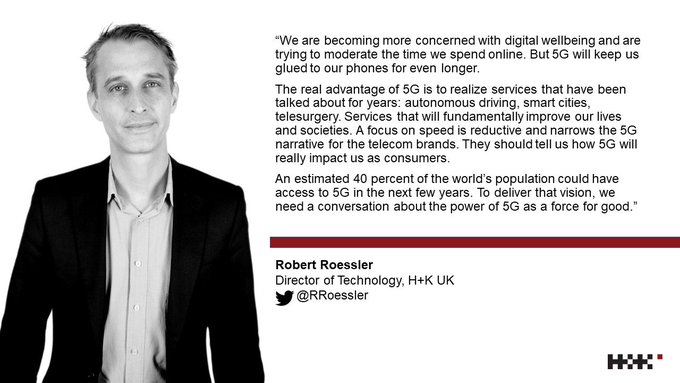
"With Donald Trump’s earlier call for 6G signals, we should reflect on whether the current hype around the “Gs” helps telecom providers—or not. They now focus on speed, with the promise that 5G will be great for gaming and watching movies. While this is true, it creates a dilemma: We are becoming more concerned with digital wellbeing and are trying to moderate the time we spend online. But 5G will keep us glued to our phones for even longer. The real advantage of 5G is to realize services that have been talked about for years: autonomous driving, smart cities, telesurgery. Services that will fundamentally improve our lives and societies. A focus on speed is reductive and narrows the 5G narrative for the telecom brands. They should tell us how 5G will really impact us as consumers. An estimated 40 percent of the world’s population could have access to 5G in the next few years. To deliver that vision, we need a conversation about the power of 5G as a force for good."

Promoted via @HKStrategies:

Image


3 May 2019

Blog post: The solace of secure quantum computing

“The only way to beat a machine is with another machine.” – Alan Turing
A recent story that physicists reversed time using quantum computing immediately grabbed my attention. It is a great read about how scientists restored a quantum computer to the state it had been in a moment earlier. I find this mind-blowing and confusing in a nice way, and there has been a fascinating debate around whether the experiment has anything to do with reversing the flow of time – or nothing at all.
I have to admit that I do not have a very clear opinion on whether time might be theoretically reversible. I kind of hope that it is, but equally I hope it isn’t. But what is clear to me is that the possibilities of quantum computing are vast and as a field it is simply very different to “normal” computing. Quantum computers calculate things simultaneously rather than going through calculations in sequenced, chronological order, where speed is limited by the laws of physics. If a “normal” computer is an Aston Martin, a quantum computer is a supersonic speed rocket. It is much, much faster.
This new understanding of computer speed results in two views: one that acknowledges how “good” causes can be accelerated, such as pharmaceutical discoveries or more accurate atmospheric models to help us understand and combat climate change. This idea of “humanizing quantum computing” is diametrically opposed to the one which predicts chaos and problems, for example by using quantum computing to crack the encryption mechanisms we currently consider sophisticated and secure.
Computers typically break passwords by going through combinations of characters and numbers – a process known as “brute forcing”. The time it takes for a computer to find the right combination is defined by password complexity and length. A password with eight random lowercase characters should take a contemporary supercomputer – a machine which is 100,000 times faster than a desktop computer – no longer than two seconds to break. Passwords with lower and upper case characters are broken in less than eight minutes; lower and upper case characters with numbers in around half an hour. Adding symbols increases this to some four hours. If you want to be on the safe side, use at least 10 characters and include a mix of numbers, lowercase letters, uppercase letters and symbols. This will keep one of today’s mid range supercomputers busy for three years, in which time hopefully you will have changed your password anyway.
Supercomputers will continue to gain speed and power, so the time taken to complete tasks like breaking passwords will be revised down significantly in the coming years. But whatever speed supercomputers gain, quantum computers will make them look like novices, like an under-8 football team taking on Juventus Turin. So going back to the password cracking task and considering the extra power of quantum computers, the theory is that quantum computing can break passwords much more easily – including the ones we think are extremely long and complex. Another theory argues that quantum computing could turn into supervillains, able to break the security mechanisms on which blockchain relies. As more and more applications such as loyalty cards or personal health records are built on underlying blockchain technology, the concern is that quantum computing might put our health and finances in danger.
All of this seems plausible to me, more or less. But the development of quantum computing is driven by the motivation to achieve benefits for us as people. Its objective is to make our world cleaner, better and safer. Whilst quantum computing might be used by criminals, its emergence is likely to accelerate the development of powerful new mechanisms which will be more secure and quantum-proof. It is likely that these will be developed well before quantum computing becomes a reality.
For now, time travel and password cracking make great headlines. They also give quantum computing and science as a whole a negative image. If the public thinks that a technology is incredibly esoteric, they will feel confused. And confusion can often lead to rejection and fear. This is why technology needs to be explained carefully and in a non-sensationalist way. Quantum computing may still be in its infancy but it is only a matter of time for it to be more widely deployed. When it arrives, we might be shaken, but should not be stirred. We should understand the risks it carries, but even more so embrace the opportunities it will bring.

Published 03 May 2019 on hkstrategies.com:
https://hkstrategies.co.uk/the-solace-of-secure-quantum-computing/

21 December 2018

Mention: PR Place December 2018

PR Place quoted me and my recent blog post on the future of cash in their weekly summary:
https://www.prplace.com/blog/posts/2018/december/this-week-in-pr-21-december/

18 December 2018

Blog post: Going, going, gone: the future of cash

I love thinking about my 1980s family holidays in Italy. Weeks spent on beaches, in ice cream shops, pizzerias and gaming arcades. Phone calls back home were strictly kept to three minutes as they were so ridiculously expensive. Everything was paid in cash. I remember how excited I felt when I was a Lira millionaire. It was exotic and precious.

As you can see, I have a very emotional attachment to cash. I like that I have much better control over how much I spend and that my children can use to learn how the financial system works. But I do not think that cash is very practical. I actually very rarely have cash with me. At a fun fair a few weekends ago, I had to hurry 10 minutes to a cashpoint and back so I could buy tokens for the rides, as the organisers did not accept cards. Without enormous pressure from various children, I would have walked on for sure.

I do not think cash is safe either. The number of people I personally know who have had cash stolen from them is in the dozens. Including myself. The number of people I know who had their bank card stolen and money taken from their account is – one. And their bank paid back the money within days as it could easily spot an unusual spending pattern. So if carrying cash is more risky, would it not make sense to get rid of it? It is exactly what Sweden does. But going completely cash-free is politically sensitive.

Cash does have its prize

Governments keep cash alive because it is a social method of making payments. It is accessible to everyone and it does not discriminate against anyone. It is the key payment method for the millions of people who do not have a bank account and are not able to use a card or mobile phone to make payments. When I was a teenager, my grandmother gave me the ‘secret handshake’. What made this gesture so meaningful was that there was an immediate tangible and therefore emotional result. Had she transferred money to my bank account it would have had a very different emotional effect on me. Yet, money is money, and the way it is being handled and passed on does not define its value.

What defines value though is cost. And cash is expensive. It needs to be designed, manufactured, transported, protected, counted and destroyed. Numbers that circulate indicate that the cost of cash is £130 per person per year. Many of us use price comparison websites to shave off a few pounds of our monthly mobile phone bills. If we add cost to the cash equation, it makes increasingly less sense to use it.

Cash – the only stalwart of privacy

A key argument for cash is the anonymity it provides. I am very much pro-privacy and try to avoid giving too much data about myself away. I do not, really, want anyone or any business to know how, where and when I spend my money, and to predict or even influence what I am going to do next. Yet I still prefer cards over cash. They are simply more secure and more convenient.

But for me, cards are transitional only. Once crypto-currencies evolve into a mainstream payments method and can be used for day to day financial transactions, the discussion around convenience vs security vs anonymity will become irrelevant. We will then be able to make payments in a private, anonymous and secure way. No more cards, no more cash needed. These currencies will likely be issued by national central banks, but neither private banks nor card providers can then control, dictate or profit from the way we choose to pay for goods and services.

When talking to our clients, most agree that this will take many years to get there, but the current state of payments is unsustainable and will drive adoption. The current situation is neither cashless-friendly nor cash-friendly. Most shops accept cards and sometimes only accept card payments, yet we still need cash machines to pay at festivals, market stalls or fun fairs. Having parallel payment infrastructures in place is neither efficient nor helpful.

The future is digital. It is not cash

Our lives have become digital. We WhatsApp our friends rather than calling them, and we send emails rather than writing letters by hand. Digital has not completely replaced the physical, and should never fully do so. But it is impacting the way we think, work and interact with each other. This is how we describe what it is our clients do when we speak to the media and other audiences: they create something new and “better” that has an impact on our lives.

Exchanging physical coins and notes is not contemporary anymore. In a few years, carrying around a small card made out of plastic will not be seen as contemporary either. Our digital lifestyles create massive shifts in our behaviours and these shifts will continue to affect the way we make payments. A recent example is the launch of Apple Pay in Germany – a country which traditionally has been cash friendly.

When it comes to cash, there is emotion on one side and practicality, convenience, security and anonymity on the other. We as human beings would not exist without our ability to have and share emotions. But if we see transactions, such as buying or selling products, as a rational way to deal with other human beings, then the way we fulfil these transactions should be rational too. Cash may not be gone yet. But it is only a matter of time before it will be a thing of the past, evoking pleasant memories.

Published 18 December 2018 on hkstrategies.com:
http://www.hkstrategies.com/united-kingdom/en-uk/going-going-gone-future-cash/

3 July 2018

Article: Telecoms must stress how they make life better

Telecom providers go through another challenging year of competition, consolidation and contraction. To be successful, telcos need to focus on other c-words: providing compelling and unique content, adjusting to consumption patterns and delivering convenience to consumers.

To do this, they will need to re-define their place in the era of tech giants that are diversifying in the experiences they bring to people and the things they talk about. More than ever, telcos now need to move the conversation away from mobile data plans and connectivity to playing a more central role in the lives of humans and societal progress. Some brands have already started with this, by talking about technologies such as Artificial Intelligence and 5G and why they are important for our lives - rather than talking about the technologies themselves. We will see more of this.

Consumers will align with telecom providers only when they understand what they stand for. Communicating their purpose clearly will be vital for telco brands. Expect more business-to-human communications from them.

My comments on the c-words that matter for telcos in this BrandZ100 report:
http://online.pubhtml5.com/bydd/rxhd/#p=244

10 January 2018

Blog post: Alice in Blockchains-Land: In it for the money

Regrets, I’ve had a few. Maybe too few to mention, but there are still a few: I started looking into Bitcoin at around 2011, when its value was around $2.
I found the concept fascinatingly anarchistic and considered buying 50 BTC, to see how it worked. I thought too long about where I could legally spend Bitcoin. As BTC’s value crept up to $30 and I still had not managed to work out how to use Bitcoin, I decided not to bother.
Despite the nagging feeling of having missed something huge, virtual and cryptocurrencies still fascinate me. I do not believe that cash or cards are contemporary means of payment anymore. Similarly, I do not believe that the payments industry is the only industry on the verge of a complete technology-driven make-over. It is the Blockchain – a decentralised ledger recording data transmissions – that will change all industries forever.

A holy grail for transactions

Powering Bitcoin and many of its relatives, Blockchain has traditionally been associated with financial services, and cryptocurrencies in particular. This was the focus of CES 2017. But Blockchain is more. It makes data equally accessible for various parties. It makes records transparent and auditable, and cannot be altered – which means that transactions are safe and secure. And cheap. It is the holy grail for any transaction, combining convenience with security.
This is reflected at this year’s CES, where the discussion is in the broader context of consumer electronics. Transparent yet secure and cost-efficient transactions are crucial for many applications, including smartphones allowing users to use encrypted communication as well as to make and receive payments without having to pay fees. The Blockchain can also power ride applications between car owners and users without third party involvement. There will be authentication of medical records, a requirement for personalised healthcare which will take off this year. Several countries already record real estate contracts on blockchains. Recruiters use the Blockchain to verify candidates’ experience and qualifications.

No regrets, honestly…

Late last year, adding “Blockchain” to a company’s name seemed to be sufficient to dramatically increase a business’s value. Similar to Artificial Intelligence or the Internet of Things, we will see a flood of Blockchain-related companies and applications entering the market this year. Most of them will either fail spectacularly or go unnoticed. A few companies though will be able to find and launch applications that matter, will be able to monetise them and gradually advance Blockchain technology. It is a revolution, but a gentle and constant one.
So do I really regret not having bought Bitcoin for $2 per piece? I am actually not so sure anymore. Not being a gambler I probably would have sold them for $5 anyway. For me though, the better option is to look at companies that invest into Blockchain-powered businesses themselves. They are the ones that are likely to succeed, in the long-term.

Published 10 January 2018 on hkstrategies.com:

30 June 2014

Mention: Smart Investor 6/2014 – London

Smart Investor quoted me extensively in an article about living and working in London, published in June 2014. Here's the article (in German):
http://www.smartinvestor.de/hintergrund/smart-investor-62014-london

14 January 2014

Blog post: The times for banks they are a-changin'

2013 was not great for financial institutions: The British Social Attitudes report revealed that only 19% of the UK population think that financial institutions are well run. This makes the banking sector bottom of the league and is a far cry from 1987 when public trust in banks was higher than 90%, writes Robert Roessler.

It is too simplified to blame Lehmann, Libor and PPI mis-selling alone. Regulators with a focus on increased competition have also created an environment for non-banks to enter financial markets. They connect people and enable them to conduct financial transactions directly with each other, with no more need for a bank to be involved.

There are many examples where this has happened. Leading UK payday lender Wonga has revolutionised access to money at short notice, and in 2012 the company lent £1.2 billion in four million loans, which generated profits of more than £1 million per week. Peer-to-peer lending platforms go one step further and cut out the middle-man completely by enabling individuals to lend money to other individuals. These platforms - the most popular ones in the UK are Zopa, Funding Circle and Rate Setter - have created a win-win situation: they offer better rates to borrowers than banks as well as attractive returns for lenders.


Traditionally, financing a project or business required asking one or a small number of banks for a large sum of money. Crowdfunding reverses the approach by asking a large number of people each for a small amount of money. Even though many projects fail to get funding, there are many success stories. In 2012 an estimated £200m was raised in the UK through crowdfunding, this is likely to increase many-fold this year and the years to come.


Peer-to-peer exchanges such as Kantox and Transferwise have similar positive growth prospects. They enable individuals and companies to buy or sell currencies to counterparts directly, without a central institution exchanging one currency into another before making a payment. They are highly attractive as they charge a fraction of banks' rates, which typically include commissions, transfer fees and receiver fees.


With rising interest in these services, the question is what the banking sector is going to do. Currently they are less concerned: Transferwise's 20-30 percent growth per month and daily transfers of £1 million is impressive, but with global currency markets exchanging trillions each day this is a small drop in a very large ocean. However, disrupting technologies in combination with regulation have the potential to change an industry for good: The EU's Payments Service Directive paved the way for non-banks to offer payments services, and enabled companies such as PayPal to rapidly gain a large share of the market.


The landscape will continue to change, but banks will not give up. They will focus on core areas such as private and investment banking, as well as services such as mobile banking which they will market aggressively to increase customer loyalty. But traditional banking areas such as lending and payments will see even more alternatives to banks. And ultimately the financial revolution will encroach on an area which is so inherently linked to banks that it is hard to believe it will ever be separated: money.

Published 14 January 2014, read the full article here: http://www.thedigitalbankingclub.com/blog/the-times-for-banks-they-are-a-changin/

16 December 2013

Blog post: PC Harrington and what PRs can learn from fraudsters

I nearly became a fraud victim yesterday. Nearly, because I didn’t. But it was very close.
I received a call on my landline at around 11.30pm yesterday from PC Harrington at Holborn Police Station. PC Harrington gave me an internal police identification number and said that they had just arrested two men who skimmed my debit card to raid my bank account. The police found £1,200 when they arrested them. PC Harrington urged me to call my bank straight away and told me to not log in to my online banking account in the next 24 hours, as this would enable the fraudsters to take more money from my account.
I hung up, slightly confused. One minute later I received another call from PC Harrington, he gave me a crime reference number and asked whether I had already called my bank. He urged me to hang up and call the bank straight away, so I did and called the helpline of my bank. I spoke to Adam, who was very friendly and, after taking my name, said that there had indeed been some suspicious transactions on my account in the last two hours. He asked many questions and then asked me to type in my card details on my phone. The line became a bit crackly and when Adam mentioned my Mastercard credit card (whereas I’m with Visa), finally – finally! – the penny dropped.

Published 16 December 2013, read the full article here: http://www.mhpc.com/financial/pc-harrington-and-what-prs-can-learn-from-fraudsters/

13 December 2013

Blog post: The Rise of Bitcoin

Back in March 2013, Bitcoin reached an all-time trading high of more than £21. At that time, this was seen as a major development for the alternative currency which was launched in 2009, largely unnoticed outside the crypto-currency world. Since then, the situation has changed dramatically. What was seen as hype in March has now developed into a frenzy.
By the beginning of April, one Bitcoin was already worth £150. And since a US Senate committee hearing in November backed Bitcoin as a legitimate financial service, its value really took off: following a peak of £755 on 5 December, it is currently trading at around £550.
Why has Bitcoin some attractive so quickly? How exactly does Bitcoin work? And how do regulators see the currency? Here are some facts which describe what Bitcoin is - and what it’s not.

Published 13 December 2013 on entrepreneurcountry.com, read the full article here: http://www.entrepreneurcountry.com/united-kingdom/item/the-rise-of-bitcoin


29 November 2013

Blog post: The week in the media: Trading & Technology

This week was good for Bitcoin as its value soared to an all-time high of more than $1,000 on Thursday. Its worth has doubled since a US Senate committee hearing earlier this month backed Bitcoin as a legitimate financial service. Launched in 2009, the alternative currency can be traded anonymously and freely worldwide and is increasingly seen as an efficient way of handling global money transfers. The increased valuation also means that Exante’s Bitcoin fund is the best performing hedge fund so far in 2013 with a return of 4,847%.
On Monday, five major US banks said they would fund a new electronic bond trading venue on Tradeweb, a company owned by Thomson Reuters and a consortium of banks. This is regarded as an attempt to improve liquidity in the $9tn market for US corporate debt while retaining their control over the way securities change hands.
Published 29 November 2013, read the full article here: http://www.mhpc.com/financial/the-week-in-the-media-trading-technology/

8 May 2013

Blog post: Perception is bitcoin’s biggest battle


Along with the general media attention bitcoin has attracted in recent months, there’s been much talk about whether bitcoin is merely a tool for financial speculation … or is a currency as real as any other, capable of being used to buy and sell goods, as well as for investment purposes.The media frenzy accompanying the bitcoin roller-coaster of late has resulted in a surge of demand. Transaction volumes are steadily increasing and more online outlets now accept bitcoin payments. Consequently, players in the bitcoin ecosystem have fared well: With $120 million (US) in trading volumes in March 2013 (as reported by Mt.Gox, the largest bitcoin exchange) and a trade commission of 0.6 percent, this equates to revenues of around $1 million per month.With low operating costs, that means substantial profits. This has led some to speculate that the bitcoin marketplace could create billion-dollar businesses. Even if this might be exaggerated, bitcoin – and bitcoin exchanges in particular – could in fact become attractive investments for venture capital firms at some point.


Published 8 May 2013 on coindesk.com, read the full article here: 
http://www.coindesk.com/how-investment-worthy-can-bitcoin-be/

1 March 2013

Blog post: 7 things you thought you knew about Bitcoin (but that are wrong)


Bitcoin has made headlines again yesterday, reaching an all-time trading high of more than £21. This is a significant development for the fairly new alternative currency, which started at Zero in 2009. Bitcoins has slowly and quietly become a global phenomenon which is featured prominently in the media, and has started to attract the special attention of global regulators.
So how exactly does Bitcoin work? Here are seven myths which describe what Bitcoin is, and – more importantly – what it not is.


Published 01 March 2013 on whiteboardmag.com, read the full article here: http://www.whiteboardmag.com/7-things-you-thought-you-knew-about-bitcoin-but-that-are-wrong/